

By: [email protected]
Published October 26, 2024 at 03:38 AM
Was AI An Accident?
This post asks the big question: were AI breakthroughs like LLMs carefully planned, or did we just stumble into genius? Plus, we take a fun peek at what might come after neural networks!
Was AI An Accident?
I've had a lot of conversations over the last couple of years focused around one basic question — does AI (namely ChatGPT) actually think?
The truth is, many of our most impressive AI breakthroughs weren't carefully designed to mimic human cognition—they were happy accidents that emerged from scaling up pattern-matching systems.
To be blunt, they were kinda accidents. That's not to say people much smarter than me didn't work hard to get there, but the actual breakthroughs were often unplanned.
I think it's an interesting story and can kind of help us understand where we're going next.
The Shift from Rules to Learning
From its inception, AI was about mimicking intelligence—but we didn't quite know how to get there.
Early AI was built on rules and logic—if X, then Y — revolutionary, I know.
It was our first naive attempt to encode human reasoning into machines. But this approach hit a wall when faced with complex tasks like recognizing images or understanding language. The breakthrough came when we stopped trying to explicitly program intelligence and instead let machines learn from data.
The Rocky Road to Deep Learning
The journey from rule-based systems to modern AI wasn't a straight line.
Back in 1957, Frank Rosenblatt created the Perceptron—basically a digital neuron that could learn simple patterns. It was pretty cool until they realized it could only learn very basic stuff like straight lines.
This 'didn't fully capture the complexity of the human brain' though, even by 1950's standards, so people got kinda disillusioned with neural networks for a while.
That said, I think it's interesting to remember that this tech itself is far from new. It's just that we've only recently had the computing power to make it feasible.
The Backpropagation Revolution
In the 1980s, researchers figured out how to efficiently train neural networks using something called backpropagation.
In simple terms, it's like giving the network feedback about its mistakes so it can adjust and learn.
The Rise of Machine Learning
Through the '90s and early 2000s, researchers started developing all sorts of clever machine learning tricks:
- Support Vector Machines (SVMs) became the hot new thing
- Random Forests showed how simple decision trees could work together
- Kernel methods helped computers find patterns in complex data
But neural networks were still kind of sitting on the sidelines. They worked in theory, but again, computers weren't fast enough to make them practical.
The Netflix Prize and Big Data™
Around 2006–2009, the Netflix Prize competition showed how combining different ML approaches could solve real-world problems. Teams competed to predict what movies people would like, and it turned out that mixing multiple algorithms worked better than any single approach.
This was when people started realizing that:
- Having lots of data was really important
- Computing power was becoming a game-changer
- Complex problems needed complex solutions
This was the beginning of the "Big Data™" era—when people started realizing that having massive amounts of data could unlock entirely new possibilities.
The AlexNet Moment: Right Place, Right Time
The 2012 ImageNet competition changed everything.
That's when AlexNet demonstrated unprecedented accuracy in image recognition.
But here's the fascinating part: AlexNet's architecture wasn't radically new. The real magic came from:
- GPUs becoming powerful enough to train deep networks
- Large datasets becoming available
- Simple but effective tweaks like ReLU activations and dropout
It was less about brilliant design and more about having the right ingredients at the right time. This accidental confluence of factors launched the deep learning revolution.
Word Embeddings: Unexpected Mathematical Poetry
When researchers developed word embeddings like Word2Vec, something surprising emerged.
Not only could words be represented as vectors, but these vectors captured semantic relationships no one explicitly programmed.
Huh?
The classic example that I think will help a lot is to imagine the words 'king' and 'queen'. If you map those to vectors, you can actually do some pretty cool math with them.
That math tends to be very interesting when mapped out and computed in vector space. For example:
king - man + woman ≈ queen
These relationships weren't programmed—they emerged naturally, which is a bit odd to say the least.
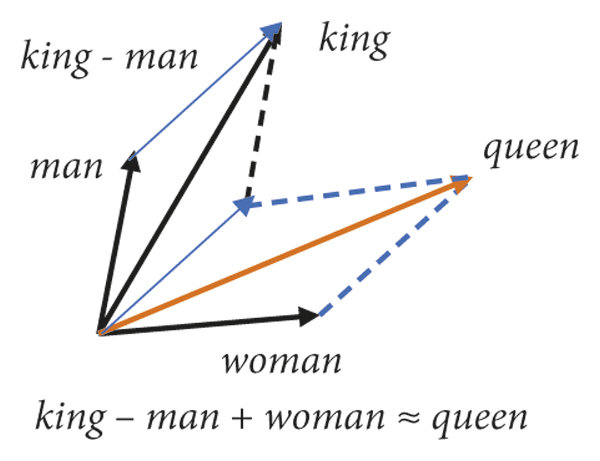
Worth noting, these vectors are not in 2D like this image shows, but in a much higher-dimensional space—like in the hundreds if not thousands of dimensions.
Another classic example is:
Paris - France + Italy ≈ Rome
All by 'accident' pretty much. The model learned that capital cities have a similar relationship to their countries, just as kings have a similar relationship to queens. Pretty wild, right?
I think this is actually super interesting. I almost wrote a blog post just about word embeddings, but I'll leave that to the experts if you're interested—MIT blog post.
The Transformer Revolution: Scaling Changed Everything
The 2017 introduction of transformers, shockingly, wasn't revolutionary because of their core design.
The self-attention mechanism was clever, but the truly shocking discovery was how transformers behaved when scaled up.
As these models grew larger, they didn't just get better at their training tasks—they developed capabilities no one had predicted:
- Few-shot learning (learning from just a few examples)—eventually zero-shot learning (doing tasks with no examples at all!)
- Task generalization—models trained on one task could perform well on others
- Emergent reasoning abilities—the question of the day!
This "scaling hypothesis" wasn't part of the original plan, but as seen in recent years, there's been a lot of incentive to keep scaling up models.
Modern LLMs: Pattern Matching at Scale
Today's Large Language Models like GPT-4 can engage in what appears to be reasoning, coding, and even creative writing.
But here's the key insight: they're not actually reasoning in the way humans do. They're performing incredibly sophisticated pattern matching across their training data.
The "intelligence" we see in these systems is emergent—it arises from scale and architecture rather than being explicitly designed. This is why they can sometimes:
- Solve complex problems in unexpected ways
- Make surprisingly creative connections
- Also fail at seemingly simple logical tasks
What This Means for AI's Future
Understanding AI's accidental evolution has important implications:
-
Scaling Isn't Everything: While scaling has led to impressive results, we might be approaching diminishing returns. The next breakthrough might require fundamentally new architectures.
-
Emergence Matters: Instead of trying to directly program intelligence, we should focus on creating conditions where sophisticated behaviors can emerge naturally.
-
New Paradigms Needed: True reasoning, causality, and general intelligence might require completely different approaches than our current pattern-matching systems.
Looking Forward
The next major AI breakthrough probably won't come from trying to directly mimic human intelligence. Instead, it's likely to emerge from:
- New computing paradigms (quantum, neuromorphic)
- Better ways to combine different AI approaches
- Fundamental advances in how we represent and process information
The question isn't whether AI will think like humans—it's what new forms of intelligence we might accidentally discover along the way.
Conclusion
And that's the story! Not really an 'accident' per se, but more of a series of fortunate events.
What do you think?
Will the next AI revolution be carefully designed, or will we stumble upon it like so many breakthroughs before?
Share your thoughts in the comments below, and thanks for reading!
Comments
No comments available :/
Leave your thoughts! 💭
Tags
Gen AI
ML/AI

Version Unavailable
/
unavailable
Copyright 2026 © Naztech Inc. and Daniel Nazarian