

By: [email protected]
Published January 14, 2025 at 08:08 AM
How To Launch A Satellite For Dummies
Exploring the journey from idea to launch pad, this post breaks down the complex yet increasingly accessible process of launching a satellite into space, offering insights, challenges, and tips for anyone curious about the final frontier.
How To Launch A Satellite For Dummies
Introduction
This post is a bit of a departure from the norm because it's a special week—it's launch week!
On Tuesday, January 14, 2025, my team at Planet Labs will have many of our satellites launching into space on a SpaceX Falcon 9 rocket.
I've been working at Planet for about two years now. In the simplest terms, we make satellites that take pictures of Earth from space.
I work in "Space Systems," alongside the Manufacturing teams to develop tools and software that support various manufacturing processes—from automation to testing to quality assurance. We handle a bit of everything, which I love.
It's a challenging job but one of the most rewarding professional experiences I've had.
Who Cares?
Great question!
When I started at Planet, I was admittedly nervous. It was a big shift from my typical software-focused roles—it’s very hardware-centric and one of the largest companies I've worked for.
That said, I’ve always loved space and as a software engineer, I never imagined I'd have the opportunity to work on something like this.
Beyond that, I recognized that there was likely no way I would be able to do anything space-related on my own—or so I thought. Planet itself was founded in a garage by roughly 10 people who launched something into space a decade ago. Now, they’re a billion-dollar company.
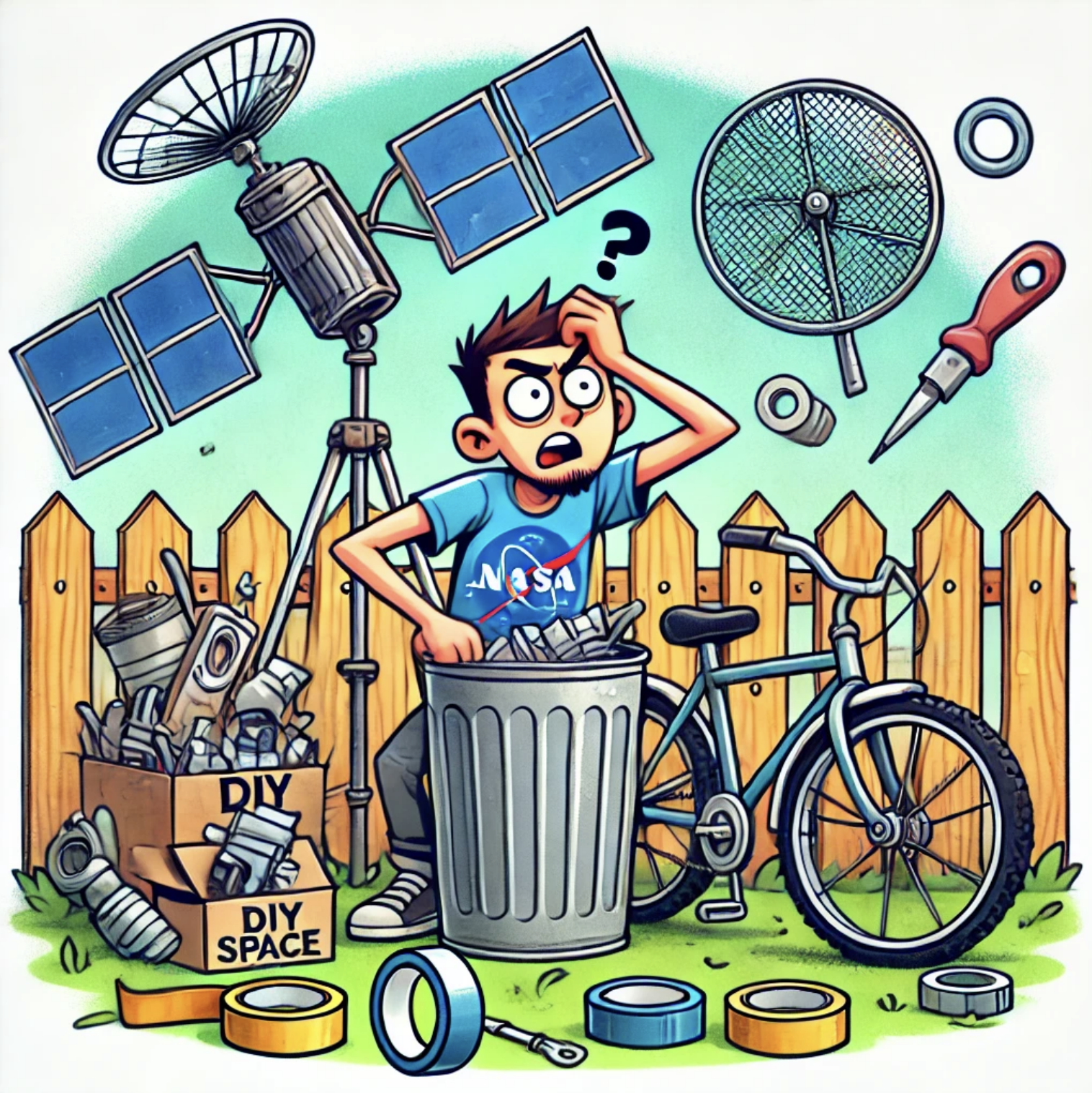
I could not shake the thought - why not me? Not even me personally but even just generally, what's stopping anyone from launching their trash can into space? Purely technical know-how?
That’s the question this post explores. I'll break down what launching a satellite actually involves—not for a billion-dollar company, but for individuals.
Disclaimer: Launching anything on your own like Planet’s founding team is extremely hard. It takes a lot of work, time, expertise, and, honestly, luck. This isn’t a definitive guide, legal advice, or an actual "how-to." It’s more of an exploration.
But Is It Hard?
TLDR, yes—but it’s possible!
What surprised me at Planet, and might surprise you, is how much more accessible space has become.
This is primarily a function of costs and really SpaceX's innovation since the early 2000s.
To give you an idea, in the 1960s, it cost roughly $100,000 per kilogram to launch something into space. Today, riding on a SpaceX Falcon Heavy or Blue Origin's New Glenn costs just over $1,000 per kilogram. More on that here.
This cost reduction has revolutionized space exploration. High schools are even launching small satellites through programs like NASA's CubeSat Initiative.
Before getting into any of the following, I will say if you're actually interested in this I would highly recommend finding some team and working on a CubeSat, they're really trying to be accessible and easy to get started with.
Legal Troubles
Okay first, hire a lawyer.
Seriously. Navigating the legal landscape of launching a satellite is complex and could really ruin your life honestly.
As you'd expect there's a lot of legal challenges:
- Regulatory Hurdles: Before you start building, you kinda need approval from agencies like:
- The Federal Communications Commission (FCC): For spectrum allocation.
- National Oceanic and Atmospheric Administration (NOAA): If your satellite has imaging capabilities.
- Federal Aviation Administration (FAA): For launch approvals.
- International Considerations: Adhere to international treaties and agreements like the Outer Space Treaty.
- Export Control: Ensure compliance with ITAR regulations if dealing with sensitive technology.
- This is a big one nowadays.
This definitely has the highest room for error in my opinion so I would definitely recommend getting help for this part - again hire a lawyer, talk to a CubeSat team advisor, etc.
Technicalities
Maybe the hardest thing to figure out in my opinion is the actual technical details.
There is physically no one stopping you from launching your trash can into space as described earlier - the cops aren't searching for people doing this because it's genuinely very difficult to have that skill set.
That said, there are some ways around this even if you're not a rocket scientist. For example, you can buy a CubeSat kit and build your own.
Even with the kit though there are some general things to consider and deal with:
- Designing the Satellite: The complexity depends on the mission
- If you're just concerned about getting it up there you can probably get away with the CubeSat.
- But even then you need to consider:
- Power systems (solar panels, batteries)
- Communication systems (radio, antennas)
- Thermal control (space is either very hot or very cold)
- Attitude control (keeping it pointed the right way)
- Structural integrity (it needs to survive launch)
- Manufacturing: This includes everything from sourcing parts to testing components in simulated space environments.
- Less big of a deal with only one satellite and a few components.
- Tolerances for things like temperature, vibration, etc. - you have very little wiggle room here.
- Components need to withstand:
- Extreme temperatures (-150°C to +150°C)
- Intense vibration during launch (up to 100Gs!)
- Vacuum conditions
- Radiation exposure
- Micrometeoroid impacts
- Testing: This is where things get really tricky
- You need specialized facilities for:
- Thermal vacuum chambers
- Vibration testing
- EMI/EMC testing (electromagnetic interference)
- Solar array deployment
- Each test can cost thousands and take weeks, this is a huge part of what we do even at Planet
- One failed test can mean redesigning everything
- You need specialized facilities for:
- Integrating with a Launch Provider: You need to meet the physical and technical specs of the launch vehicle but more on that later.
- This is a major consideration even with the CubeSat kit.
- Launch environments are brutal - your satellite needs to be incredibly robust
- Even tiny loose screws can be catastrophic
- Ground Stations: Building or leasing ground stations for communication and data collection. This is a bit of a rabbit hole that isn't super openly discussed so I don't have a ton to add but sounds expensive!
- Your ground station is going to need to be able to receive the data from the satellite which might affect your design.
- Need specialized radio equipment and licenses
- Limited communication windows as satellite passes overhead
I went a little overboard here apologies but this is the part I know best.
The designing part is likely the most important and difficult as you effectively need to be a rocket scientist. Or know one. No biggie.
Cost
Bit contradictory to what I was saying earlier I know, but launching stuff into space is still not cheap.
Here’s a rough breakdown:
- Launch Vehicle: SpaceX Falcon 9 is the most popular launch vehicle for small satellites.
- Ground Stations: $100,000 to $1,000,000 to build or lease.
- Satellite Manufacturing: Varies wildly; some CubeSat programs cost as little as $10,000.
All of the above varies wildly based on what you're trying to build. Each step can / should be a lot cheaper for a CubeSat but again not cheap - you're looking at at least $10,000s.
Launch Providers
Even if you are willing and able to spend the money, getting through to a launch provider (SpaceX, Blue Origin, etc.) is a bit of a process.
This kinda ties into technical details / design as I hinted at earlier, you need to meet the physical and technical specs of the launch vehicle.
But really the biggest bottlenecks here are going to be the costs and the time it takes to get through the process. You could wait YEARS to get a launch slot. Companies like Planet even have to plan years in advance in order to get a launch slot and even then it's a really get up or get out mentality - i.e., if you aren't ready the exact day you need to be and things aren't perfect you're out of luck.
On the brighter side there are more launch providers than ever before.
Easier Routes?
Does this sound like a lot? It should.
While space travel / launches are more accessible than ever before, they're still not easy by any stretch.
Biggest tip I can offer - find a team e.g.,:
- Join a Small Team: Partnerships with affordable launch providers make this feasible.
- Local Clubs: Universities and clubs often work on small satellite projects.
- Ride-sharing: Companies like SpaceX and Rocket Lab offer payload ride-shares.
Conclusion
While launching a satellite might sound daunting, the fact that it’s even possible for individuals to attempt is incredible in my opinion.
The advances in space technology have made what was once science fiction a tangible goal for literally anyone.
This journey—from design to launch—is a testament to how far humanity has come. With enough dedication, even an ordinary shmuck could make something extraordinary happen, like launching a trash can into space. (Should I do it? Let me know! 🗑️🚀)
As for Planet Labs, I’m excited to see how we continue to push boundaries and help others make the world a better place through innovation.
Here’s to a great launch! 🍻🚀
Resources
Comments
No comments available :/
Leave your thoughts! 💭
Tags
Planet
Space
SpaceX

Version Unavailable
/
unavailable
Copyright 2026 © Naztech Inc. and Daniel Nazarian